FAQs
As a Certified Grinberg Method practitioner working in Amsterdam, I often meet people who feel stuck with recurring pain, stress, or physical patterns that don’t seem to change. The Grinberg Method is not about fixing the body, but about learning from it—through direct experience, awareness, and choice.
Below you’ll find answers to over 40 questions about how the Grinberg Method works, what sessions are like, and whether it may be right for you.
JUMP TO FAQ CATEGORY:

[ Sessions with Leander in Amsterdam ] Practical & Logistical FAQs
-
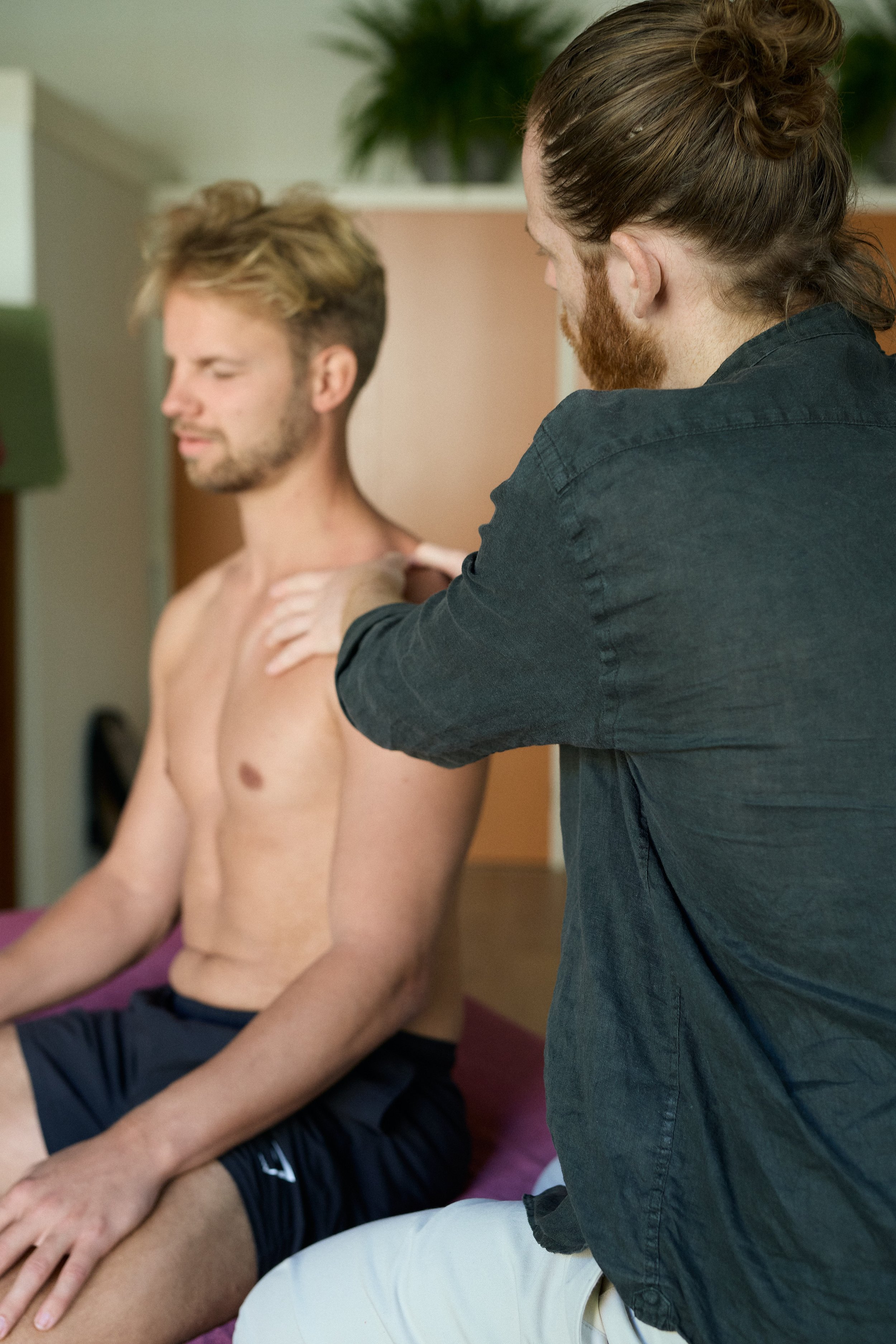
We start the session by discussing the theme / issue / challenge you want to work on. Through attentive touch and guided awareness, we explore how you hold tension, breathe, and respond to stress / emotions that are triggered when you talk about the issue.
We then work to drop or undo the the habitual patterns that show up in the body and allow space for something new and/or different to emerge.
For new clients, it’s essential we have a 20 min call prior to you booking an Intake Session.
Book a 20 min Discovery Call here »
On this complimentary call, you can share what is going on for you and ask questions. If we both feel like it’s a good fit, I will send you a private link to book a 90 min Intake Session (€135 ) .
In the Intake Session we have extra time to talk about the issues you are working on and then we will work with it through the body using breath, movement and touch.
-
New client intake sessions are €150 (90 mins)
Follow up sessions are €120 (60 mins)
-
A Grinberg Method in-take session (ie the first session) takes 90 mins and subsequent follow up sessions are 60 mins.
This allows time for conversation, observation, hands-on work, and integration of awareness without rushing the learning process.
-
Most sessions are conducted with partial clothing / underwear. However if you are more comfortable with clothes, that’s also fine.
-
No special preparation is required. Come as you are and share any relevant physical or emotional concerns.
As the certified practitioner, I’ll guide the session based on what is present in the body at that moment.
-
In most countries, including the Netherlands, the Grinberg Method is not covered by standard health insurance.
However in my experience, it’s worth checking with your employer, as some complementary or educational services may be partially reimbursed.
-
Yes, if you are a freelancer, business owner or your employer pays for you and you need a business invoice this can be provided. In that case 21% BTW (VAT) is added.
For freelancers and business owners the sessions can be seen as a business expense.When you book your Intake Session, you will be asked to fill in your business details before booking
Intake Sessions €135 + 21%BTW
Follow Up Sessions €95 + 21%BTW
-
You can reschedule or cancel your appointment free of charge 24 hours prior.
Any changes or no shows after that 24 hour period incur the full 100% fee.
Foundational FAQs
-
The Grinberg Method is a body-based learning approach that helps people become aware of physical and emotional habits/patterns that cause pain, stress, or limitation.
Through touch, guidance, and attention, clients learn how to stop their automatic way of reacting to their surroundings and so they learn how to regain choice instead of reacting automatically.
-
The Grinberg Method works by increasing awareness of bodily sensations, tension patterns, and automatic responses.
At first, it teaches you to increase your body attention. After that and in a step-by-step proces the client is made aware of what they do, that creates discomfort, stuckness, beliefs, rigidity or even chronic symptoms.
Coming from the idea that we create a big part of our own physical and emotional state, I teach the client to take back their responsibility and agency.
By using touch, movement, and verbal guidance I teach clients to become aware of these patterns and responses and so to learn how to stop repeating the same reaction.
-
The Grinberg Method is used to address chronic pain, stress, anxiety, physical limitations, recurring injuries, and emotional patterns expressed through the body.
It focuses on learning rather than treatment, helping clients understand how they contribute to their condition and how to change it.
-
The Grinberg Method is unique in its focus on learning through direct bodily experience. Instead of only talking (as in traditional therapy) or fixing or correcting the body (like in physiotherapy), the Grinberg Method teaches people to recognise how they create patterns that are limiting them in all 4 levels of their experience: thinking, doing, feeling and basic needs.
We also explore how to change those patterns to gain more energy, heal injury and create a difference experience in their life.
-
Some people notice changes within the first few sessions, while others experience gradual improvement.
Progress depends on the issue, awareness, application of the bodywork exercises and willingness to practice noticing habits in daily life.
Comparing the Grinberg Method
-
Massage focuses on relaxing muscles, while the Grinberg Method focuses on attention and awareness and learning through that. Touch is used not to fix, but to help clients feel what they are doing and understand how tension, pain, or restriction is being created and maintained.
And to go one step further, the touch that is used in my sessions is always to teach: to feel more, to relax deeper, to become aware of contractions, to discover certain postures, to explore habitual bracing, etc.
-
Psychotherapy primarily works through talking and emotional and cognitive analysis. The Grinberg Method works through the body, sensation, and direct experience.
Instead of discussing emotions, clients learn to actually feel their emotions; how they are expressed physically and what they tend to do with that natural expression.
For example: holding back, pushing it down, tensing against it, losing energy, becoming weak, thinking it is not aloud to feel that, collapsing with pressure.
-
The Grinberg Method and coaching both support personal change, but they work in different ways.
Coaching mainly focuses on conversation, reflection, and goal setting, helping people gain insight and direction through dialogue.
The Grinberg Method is a body-based learning approach that works through physical experience.
Instead of talking about challenges and asking questions, attention is brought to how the body responds in real time, allowing change to emerge through awareness, sensation, and practice rather than advice or strategies.
-
The Grinberg Method and Somatic Experiencing are both body-based approaches, but they differ in focus and intention. Somatic Experiencing is a therapeutic method primarily used to work with trauma through nervous system regulation.
The Grinberg Method is an educational approach that focuses on body attention, learning, and choice in how a person uses their body under pressure. Together with processing past events, the Grinberg Method works with present-moment physical habits and responses that have been ingrained out of a response to these events.
It’s worth trying both if you have the opportunity.
-
Yes, the Grinberg Method often complements medical care, physiotherapy, psychotherapy, and other bodywork.
It focuses on learning and awareness, which can support and enhance other forms of treatment.
Pain and Physical Conditions
-
The Grinberg Method can help people with chronic pain by identifying habitual tension, movement patterns, and stress responses that are maintaining or re-creating the pain.
Once identified, we work with clients to drop the pattern through body awareness, breath, movement and touch.
-
The Grinberg Method can help with back pain by addressing posture, breathing, and unconscious patterns of holding.
For example, clients can discover in what situations they ‘hold’ their lower back in a certain way. In the sessions they’ll learn how to relax the area and attentively tend to their back pain.
-
In my experience the Grinberg Method can help with headaches and migraines by discovering patterns on a mental, emotional and physical level that are creating the headaches.
For example: neck tension, jaw clenching, breathing restriction, difficulty focussing, and ways you respond to stressful situations might be contributing to the headache.
In the session I work with you to recognise the early signs (patterns) that often precede the headache AND you’ll learn how to drop the excess tension before the headache builds.
-
The Grinberg Method can help with joint pain by teaching the client what they do in stressful or repetitive situations that are causing the joints to become painful.
By reducing excess tension, and increasing awareness of movement habits, clients often discover how they overload certain joints and learn alternative ways of moving that distribute effort more efficiently through the body.
-
The Grinberg Method helps with posture indirectly by increasing awareness of how posture is maintained.
Instead of forcing alignment, clients learn how tension, fear or effort shape their posture and how to stand and sit with more balance, stability, and ease.
-
Yes, the Grinberg Method can help with breathing difficulties caused by tension, stress, trauma, repetition or habit.
Issues such as asthma, feeling of pressure on the chest, shallow breathing, not being able to settle in your breath and even allergies… are often layered with additional tension and fear.
In our sessions, we’ll focus on feeling and relaxing the body so you can breathe deeper and allow more air to flow.
-
In my experience, athletes and dancers often benefit from the Grinberg Method by improving recovery speed and focus.
Learning how to reduce unnecessary tension and respond calmly under pressure can enhance performance and reduce injury risk.
Stress, Emotions, Nervous System
-
The Grinberg Method helps with stress by teaching clients how they resist against the physical experience of stress and fear.
By creating body attention (feeling what happens in the body) and practicing to become aware of the body in specific situations, clients learn to recognise their way of responding to stress and they learn how to stop patterns that are limiting them in those situations.
-
The Grinberg Method can help with anxiety by working directly with physical fear responses such as shallow breathing, muscle tightening, and collapse.
For example, clients learn to stay present with the anxiety sensations and learn to stop fighting it / stop pressing it into the body.
By not automatically reacting, clients learn to relax with the stress and fear … which prevents the build up that often leads to anxiety.
-
The Grinberg Method supports people dealing with trauma by focusing on present-moment bodily responses and sensations together with revisiting past events.
By learning about the patterns that have emerged out of the traumatic event and working with the experience on a physical and emotional level, the client is able to take back agency over their life.
-
The Grinberg Method helps with emotional patterns by exploring how emotions are physical.
Clients learn how habits such as holding, collapsing, or bracing reflect emotional responses and how to interrupt these patterns through awareness, breath, movement and conscious choice.
-
The Grinberg Method can help with burnout by addressing exhaustion, over-effort, and lack of recovery.
Clients learn about how they push beyond their limits and how to recognise these signals earlier, allowing for better pacing, rest, and sustainable use of energy, together with the learned ability of healthy boundary setting.
-
The Grinberg Method can support focus by reducing internal noise created by tension and stress. Internal noise can be anything from limiting beliefs, emotions to physical pain.
Clients learn to stay present with sensation, which improves mental clarity and sustained attention.
-
Increased body awareness can influence confidence by changing how a person experiences themselves from the inside.
When posture, breathing, and physical presence become clearer and more grounded, self-perception often shifts naturally.
Confidence is not created through positive thinking, but through feeling more stable, present, and connected in one’s own body.
Confidence is a felt experience, not a mental strategy.
Certification
-
The Grinberg Method was developed by Avi Grinberg in the late 1980s. It evolved from work in body reading, reflexology, and movement education, and is now practiced internationally by certified practitioners trained through a multi-year professional program.
Read more: https://www.grinbergmethod.com/about
-
Yes, certified Grinberg Method practitioners complete a multi-year professional training program that includes observation skills, ethics, and supervised practice. Certification ensures a consistent standard of training and professional conduct.
-
There is limited formal scientific research on the Grinberg Method. It is considered an experiential and educational approach rather than a medical treatment.
Many clients and practitioners, including myself, report practical benefits through direct experience and application.
-
People with acute medical conditions, severe psychiatric disorders, or recent injuries should consult a medical professional before starting.
**The Grinberg Method does not replace medical care and works best alongside appropriate professional support.**
-
Yes, no prior experience with bodywork or awareness practices is required.
Sessions are guided step by step and are always tailor-made.
-
Results can be long-lasting because clients learn skills they can use independently.
As awareness increases, clients often recognize patterns earlier and respond differently, reducing the likelihood of recurring issues.
Other FAQs
-
Some practitioners, including myself, work with children, adapting sessions to age and capacity.
Parental involvement and clear communication are essential.
-
The Grinberg Method is traditionally hands-on, but some aspects such as awareness training and observation can be adapted to online sessions.
Effectiveness depends on the issue and the client’s learning style.
Typically, I only work with clients online after they have had at least one in-person session.
-
Noticing little sensation is also information.
As a certified practitioner, I work with numbness or disconnection as part of the learning process, helping clients gradually increase sensitivity and body attention.
-
Yes, simple awareness practices are often suggested between sessions.
These practices help integrate learning into daily life and support lasting change without requiring long or complicated exercise
-
Progress is measured through increased awareness, reduced symptoms, improved function, and greater choice under pressure.
Changes are noticed in daily life rather than only during sessions. Besides that, we set a clear aim in the beginning of the proces so we know clearly where we are going and what we are working on.
-
The goal of the Grinberg Method is to help people regain choice in how they use their body and respond to challenges. It aims to reduce unnecessary suffering by increasing awareness, responsibility, and capacity for change.
The aim of your process is always individual.